OMEGA Digital Temperature Controller CSC32-J-C2
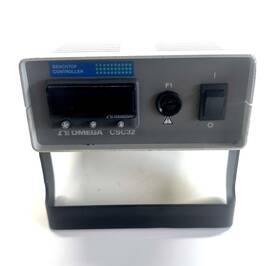
( Brand: Omega ), ( Manufacturer Part Number: CSC32-J ), ( Part Type: Digital Controller ), ( Analog/digital: Digital ), ( Country Of Origin: United States )
Review OMEGA Csc32-j Digital Temperature Controller
The **Omega CSC32-J** and its enhanced variant, the **CSC32-J-C2**, are precision-engineered digital temperature controllers designed to deliver unparalleled accuracy, reliability, and versatility for a wide range of industrial, laboratory, and commercial applications. These compact yet robust controllers feature a **4-digit LCD display** with backlighting for clear visibility in varying lighting conditions, ensuring operators can monitor temperature settings and process values with ease. The **CSC32-J-C2** builds upon the standard model by incorporating **two independent control channels**, making it ideal for applications requiring dual-temperature management, such as dual-zone ovens, incubators, or process heating systems where precise coordination between two zones is essential. Both models operate with a **resolution of 0.1 C**, providing fine-tuned control for critical applications where even minor temperature fluctuations can impact outcomes.
At the heart of the CSC32-J series lies **Omega s advanced PID (Proportional-Integral-Derivative) control algorithm**, which dynamically adjusts heating or cooling outputs to maintain setpoint stability with minimal overshoot or lag. This intelligent control mechanism is complemented by **configurable control modes**, including **ON/OFF, proportional, and PID**, allowing users to tailor the controller s response to specific load characteristics whether it s a slow-reacting industrial furnace or a rapid thermal cycle in a laboratory setting. The **CSC32-J-C2** further enhances functionality with **dual-channel PID control**, enabling synchronized or independent temperature regulation across two distinct zones, a feature particularly valuable in applications like **dual-zone annealing furnaces, food processing systems, or climate-controlled chambers**.
Safety and operational flexibility are prioritized in the design of these controllers, with **relay output options** (including SPST, SPDT, or NO/NC configurations) that accommodate a broad spectrum of actuators, such as solid-state relays, contactors, or motorized valves. The **CSC32-J-C2** extends this capability with **two independent relay outputs**, each configurable for separate control loops, while the standard **CSC32-J** offers a single robust relay for straightforward applications. Both models include **over-temperature protection**, automatically shutting down the system if the temperature exceeds predefined safety limits, thus preventing equipment damage or process failures. Additionally, the controllers feature **remote sensing inputs** via **J-type, K-type, or T-type thermocouples**, ensuring accurate temperature measurement at the process point rather than at the controller location, which is critical for maintaining precision in environments with significant thermal gradients.
The **CSC32-J series** is built to withstand demanding environments, with a **durable metal enclosure** rated for **IP65 protection**, shielding against dust, moisture, and accidental spills. The controllers operate within a **wide ambient temperature range of -10 C to 60 C**, making them suitable for both indoor and outdoor installations in various climates. Power requirements are modest, with **110V or 230V AC operation** (configurable via DIP switches) and a **low power consumption** of just **10VA**, ensuring energy efficiency without compromising performance. For enhanced usability, the controllers include **user-friendly front-panel controls**, including **up/down adjustment knobs, a setpoint entry button, and a mode selection switch**, allowing for intuitive configuration without the need for external programming tools.
The **CSC32-J-C2** stands out with its **additional features**, such as **dual-channel setpoint programming**, **individual PID tuning for each channel**, and **relay interlocking**, which enables synchronized or staggered control between the two zones. This dual-channel capability is particularly advantageous in **pharmaceutical manufacturing, materials testing, or food preservation**, where maintaining precise temperature differentials between zones is essential for process integrity. Both models also support **remote setpoint adjustments** via **4-20mA analog input**, enabling integration with larger control systems or SCADA platforms for centralized monitoring and automation.
Whether deployed in **laboratory ovens, industrial furnaces, HVAC systems, or precision cooling applications**, the **Omega CSC32-J** and **CSC32-J-C2** deliver a harmonious blend of **accuracy, adaptability, and durability**. Their **modular design, extensive connectivity options, and intuitive interface** make them a seamless fit for both new installations and retrofitting existing systems. With Omega s reputation for **industrial-grade reliability** and a focus on **user-centric design**, these temperature controllers empower engineers and operators to achieve **consistent, repeatable results** with confidence, ensuring optimal performance across a diverse range of temperature-sensitive applications.
The **Omega CSC32-J** and **CSC32-J-C2** are digital temperature controllers designed for industrial and laboratory applications, offering precise temperature regulation for ovens, furnaces, and other heating systems. Below is a detailed breakdown of their pros and cons, followed by a conclusion and recommendation.
---
### **Pros of the Omega CSC32-J and CSC32-J-C2**
1. **High Precision and Accuracy**
Both models provide accurate temperature control with a resolution of **0.1 C** and an accuracy of ** 0.5 C** (typical). This makes them suitable for applications requiring tight temperature tolerances, such as material testing, annealing, or chemical processes.
2. **Dual-Channel Control**
The **CSC32-J-C2** includes **two independent control channels**, allowing simultaneous control of two separate heating elements or zones. This is useful for applications like dual-zone furnaces or processes requiring independent temperature management (e.g., gradient heating).
3. **Relay Outputs for Direct Control**
Both models feature **two SPDT relay outputs** (with optional **SSPC or SSR outputs** for the C2 model), enabling direct control of heating elements, motors, or other high-power devices. This eliminates the need for additional relays in many setups.
4. **User-Friendly Interface**
The **large, backlit LCD display** with intuitive navigation makes it easy to set and monitor temperatures. The menu-driven interface simplifies programming of setpoints, ramp rates, and hold times.
5. **Programmable Ramp and Soak Cycles**
Both controllers allow for **customizable ramp rates** (temperature change per minute) and **soak times**, which are essential for processes like heat treatment, curing, or drying where gradual temperature changes are required.
6. **Wide Temperature Range**
The controllers can handle **temperature ranges from -50 C to 1000 C**, depending on the sensor used (e.g., K-type thermocouples). This versatility makes them adaptable to various industrial and laboratory applications.
7. **Modular and Expandable**
The **CSC32-J-C2** supports **optional modules** such as PID tuning, data logging, or additional communication interfaces (e.g., RS-485). This modularity allows for future upgrades without replacing the entire unit.
8. **Over-Temperature Protection**
Both models include **high-limit and low-limit alarms**, which can trigger relays or shut down the system if temperatures exceed safe thresholds, preventing equipment damage.
9. **Durable and Reliable Build**
Omega is a well-established brand known for **industrial-grade reliability**. These controllers are built to withstand harsh environments, with robust enclosures and stable performance over long periods.
10. **Compatibility with Omega Sensors**
They work seamlessly with **Omega s range of thermocouples and RTDs**, ensuring consistent and accurate readings across different applications.
11. **Local and Remote Monitoring**
While basic models lack advanced networking, the **CSC32-J-C2** can be integrated with **Omega s SCADA software** or other monitoring systems for remote oversight.
12. **Low Maintenance Requirements**
With minimal moving parts and a solid-state design, these controllers require **few adjustments or replacements**, reducing downtime.
---
### **Cons of the Omega CSC32-J and CSC32-J-C2**
1. **Limited Advanced Features Without Add-Ons**
The **base models lack built-in PID tuning tools** or **automatic calibration**. While PID parameters can be adjusted manually, users without experience may need to rely on Omega s support or external tools for optimal performance.
2. **No Built-In Data Logging (Standard)**
The **CSC32-J** does not include **internal data logging**, requiring users to purchase an optional module (e.g., **CSC32-J-DL**) or connect to an external system. This can be inconvenient for applications requiring historical temperature records.
3. **No Wireless or Cloud Connectivity (Base Models)**
Unlike some modern controllers, these models **do not support Wi-Fi, Bluetooth, or direct cloud connectivity** without third-party interfaces. Users needing remote access must rely on **RS-485 or proprietary software**.
4. **Relay Contact Ratings May Be Insufficient for High-Power Applications**
The standard **SPDT relays** have **limited current ratings (typically 10A at 250VAC)**. For high-power heating elements (e.g., kilns or large furnaces), **solid-state relays (SSRs)** or **higher-rated relays** may be required, adding to the cost.
5. **Learning Curve for Advanced Features**
While the interface is user-friendly, **programming complex ramp-soak cycles or PID tuning** may require familiarity with temperature control principles. Beginners might need guidance from Omega s documentation or support.
6. **No Touchscreen or Touch Controls**
The **menu-driven navigation** can be slower than touchscreen interfaces found in some newer controllers. This may not be an issue for most users but could be a drawback in high-throughput environments.
7. **Limited Communication Protocols**
The **CSC32-J-C2** supports **RS-485 (Modbus RTU)**, but lacks **Ethernet, USB, or common industrial protocols** like Profibus or CAN. This restricts integration with modern SCADA or PLC systems without additional converters.
8. **Sensor Dependency**
The accuracy of the controller depends entirely on the **quality of the thermocouple or RTD** used. A faulty or improperly installed sensor can lead to **inaccurate readings and poor control**, requiring regular calibration checks.
9. **No Built-In Self-Diagnostics**
Unlike some advanced controllers, these models **do not provide detailed self-diagnostic reports** for relay failures, sensor disconnections, or communication errors. Troubleshooting may require manual checks.
10. **Higher Cost for Advanced Features**
While the **base models are reasonably priced**, adding features like **data logging, PID tuning, or SSR outputs** increases the total cost. For users needing these features out of the box, alternatives may offer better value.
11. **Limited Customization for Special Applications**
The controllers are **general-purpose** and may not include **specialized functions** (e.g., vacuum control, humidity regulation, or multi-zone mapping) without additional hardware.
12. **Physical Size and Installation Space**
The controllers occupy **some space on a control panel**, which may be a constraint in compact setups. The **CSC32-J-C2** is slightly larger due to its dual-channel design.
---
### **Conclusion**
The **Omega CSC32-J** and **CSC32-J-C2** are **reliable, precise, and versatile** temperature controllers well-suited for **industrial, laboratory, and process control applications** where **dual-channel control, relay outputs, and programmable cycles** are required. Their **accuracy, durability, and compatibility with Omega sensors** make them a strong choice for users prioritizing **performance and ease of use**.
However, they **lack advanced features** such as **built-in data logging, wireless connectivity, or modern communication protocols** without additional modules or accessories. Users needing **high-power relay control, remote monitoring, or automated logging** may find these controllers **less convenient** compared to newer, more integrated systems.
For **basic to intermediate temperature control needs** especially in **small to medium-scale furnaces, ovens, or annealing systems** these controllers offer **excellent value**. For **highly automated, data-intensive, or networked applications**, a more modern controller with **built-in logging, Ethernet, or touchscreen interfaces** might be preferable.
---
### **Recommendation**
- **Buy the Omega CSC32-J or CSC32-J-C2 if:**- You need **two independent temperature control channels** (CSC32-J-C2).
- Your application requires **precise ramp-soak cycles** and **relay-based control**.
- You are working with **Omega sensors** and prefer a **proven, industrial-grade controller**.
- You do not require **wireless connectivity, advanced data logging, or PLC integration** out of the box.
- Budget is a consideration, as these controllers offer **good performance at a reasonable price**.
- **Consider Alternatives if:**- You need **built-in data logging** (e.g., **Omega CSC32-J-DL** or **other controllers with SD card logging**).
- **Remote monitoring or cloud connectivity** is essential (look for **Ethernet-enabled controllers** like **Omega CSC32-J-NET** or **other brands with Modbus TCP**).
- Your application requires **high-power SSR outputs** (consider **Omega CSC32-J-SSP** or **third-party SSR modules**).
- You prefer **touchscreen interfaces** or **simpler programming** (e.g., **LabJack, PID controllers with graphical interfaces**).
- You need **multi-zone mapping or advanced PID tuning tools** (some **PLC-based systems** may be more flexible).
For most **traditional industrial or laboratory setups**, the **Omega CSC32-J-C2** remains a **solid, cost-effective choice** that balances **precision, reliability, and functionality**. However, if your requirements extend beyond basic temperature control, evaluating **modern alternatives** may yield better long-term flexibility.
Details:
This digital controller is designed for precise temperature control in industrial automation and motion systems.
part #: csc32 prices
- $87.50-$199.99
specifications temperaturcontr:
- brand: Omega
- mpn: Csc32-j
- part type: Digital Controller
- analog/digital: Digital
- country of origin: United States
returns temperaturcontr:
- method: Money back
- paid by: Buyer
- policy: Returns Accepted
- time: 30 Days
seller temperaturcontr:
- rating: 96.3%
- # reviews: 150
- city: San Antonio, Texas
shipping temperaturcontr:
- cost: $9.25
- type: Fixed
- transit: 5-11 Days
- service: USPS Ground Advantage
- class: Standard
- carrier: USPS
payments temperaturcontr:
- wallet: Google-pay
- credit card: Visa
- other
general temperaturcontr:
- condition: Used
- PLCs HMIs > PLC Peripheral Modules > PLC Temperature Modules
offer temperaturcontr:
- sold: 0
- availability: In Stock
- best offers: True
- started: March 14, 2026
- quantity: 1
- options: Ship-to-home
Omega CSC32 Is Similar To:
- 038829t Omega Model Cn4521tr-r1 Temperature (44.9% similar) Please view photos for further cosmetic details. It was proven fully operational. Item facts manufacturer Omega model number CN5121TR-R1 condition used or new. Qty included in this sale. Although it was used is in excellent cosmetic condition. Excellent shipping dimension weight 8 x8 4KG manual, ...(November 1st, 2017)
- 0894 Pb Omega Temperature Controller (61.5% similar) Up for offer temperature controller 0894 Pb from Omega this was in storage and is untested so please buy knowing that working condition unknown comes as pictured with minimal wear...(October 13th, 2017)
- 1310506 Omega High Performance Temperature (43.3% similar) Omega high performance temperature process indicator model: DP41-V-ASERIAL no. 1310506 volts : 115 vac watts : 10W max...(July 10th, 2017)
- 158-713 Omega Temperature Controller Range (57.7% similar) Selling as-is for parts repair. Has some screen bleed. Comes from reliable source. Comes as shown. Used items have a 30-DAY return...(November 15th, 2018)
- 1612-1-0-899c Omega Engineering Temperature Controller (56.9% similar) Working, unable to fully test...(May 1st, 2017)
- 165-712-713-718 Omega Temperature Controller Range (53.3% similar) Used items have a 30-DAY return. Has some cosmetic wear. Comes as shown. No means to test. Comes from reliable source...(November 14th, 2018)
- 199-p2-x-x Omega Engineering Digital Thermometer Model Nos (38.9% similar) Included is the original manufacturer certificate of calibration, from 1985 . Available here is a great vintage, nos item: 1 Omega engineering digital thermometer, model 199 P2-X-X, in its original package and 100 unused. The Omega model 199 is a full-performance digit digital thermometer for ...(February 5th, 2019)
- 199-kf-x-x-ds Omega Digital Temperature Indicator (57.7% similar) It's often to late to solve them if you wait. Elector Marvin is a 9/5 Mon Fri business...(March 25th, 2016)
- 4001-jf-t Omega Temperature Controller (60.2% similar) Free us shipping. Omega 4001-JF-T temperature controller condition: working condition unknown, untested, shows signs of previous use and shelf wear from storage. Selling as-is, for parts or repair...(January 12th, 2017)
- 4002-jf Omega Temperature Controller For (58.9% similar) Note: unit is being sold as non-working for parts only...(April 28th, 2017)
- 4002a-jf Omega Digital Setpoint Temperature Controller Thermocouple (59% similar) Used Omega type j Thermopylae ranged f temp controller...(December 9th, 2018)