CAL CONTROLS Temperature Controller 9500 95111PB009
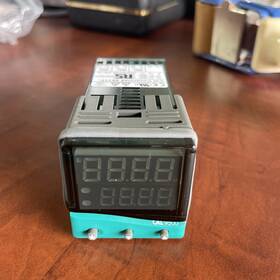
( Brand: Cal Controls ), ( Manufacturer Part Number: 95111P ), ( Part Type: Controller ), ( Location: Back Shelf 5 Row 4 )
Review CAL CONTROLS Temperature Controller Code
The **95111P (9500 Series) Temperature Controller with Model 95111PB009** is a high-performance, programmable industrial temperature control unit designed for precision applications in manufacturing, laboratory settings, and automated processes. Part of the robust **9500 Series**, this controller combines advanced digital technology with reliable analog functionality to deliver exceptional accuracy, flexibility, and ease of use. Engineered with a **4-digit LED display**, it provides clear, real-time feedback on setpoint temperatures, actual readings, and control status, ensuring operators can monitor performance with confidence. The unit features a **PID (Proportional-Integral-Derivative) control algorithm**, allowing for fine-tuned temperature regulation with minimal overshoot and fast response times, making it ideal for applications requiring tight process control such as heating, cooling, or thermal cycling.
The **95111PB009** variant is equipped with **two programmable setpoints**, enabling dual-temperature control or sequential operation for complex processes like annealing, curing, or phase changes. This dual-setpoint capability enhances efficiency by automating transitions between different temperature zones without manual intervention. The controller supports **multiple input/output options**, including **analog (4-20mA) and relay outputs**, as well as **digital I/O ports** for interfacing with sensors, actuators, or external systems. Its **relay output** provides robust switching for high-power loads, while the **analog output** allows seamless integration with PLCs, data loggers, or other automation systems. Additionally, the unit offers **remote sensing capability**, ensuring accurate temperature measurement at the process point rather than at the controller location, which is critical for maintaining precision in large or variable environments.
Built for durability, the **95111P** is housed in a **compact, rugged metal enclosure** that protects against dust, moisture, and electrical interference, making it suitable for harsh industrial environments. Its **wide operating temperature range** (typically -10 C to 60 C) ensures reliable performance in diverse conditions, while its **low power consumption** minimizes operational costs. The controller also includes **fail-safe features**, such as **over-temperature protection** and **short-circuit prevention**, to safeguard both the process and connected equipment. Programming is intuitive, with **menu-driven navigation** via front-panel buttons, allowing users to configure parameters such as PID tuning, ramp/soak cycles, and alarm thresholds with ease. For advanced applications, the **95111PB009** supports **RS-485 communication**, enabling remote monitoring, logging, and control via industry-standard protocols like Modbus RTU, facilitating integration into larger automation networks.
Whether used in **semiconductor manufacturing, pharmaceutical processing, food production, or materials testing**, this temperature controller delivers the precision, reliability, and adaptability required for critical applications. Its **versatile input options** including **J, K, T, E, N, R, S, B, and C thermocouples, as well as RTD (Pt100) sensors** ensure compatibility with a wide range of temperature measurement devices. The **95111P (9500 Series) with 95111PB009** is not just a controller; it is a cornerstone of efficient, high-quality temperature management, empowering operators to achieve consistent results while reducing manual intervention and human error.
The **95111P** and **9500** series temperature controllers (specifically the **95111PB009**, a variant of the **95111P**) are industrial-grade devices commonly used in applications like heating, cooling, and process control. Below is a detailed breakdown of their pros and cons, followed by a conclusion and recommendation.
---
### **Pros of the 95111P/9500 Series Temperature Controllers**
1. **Reliability and Durability**
- Built for industrial environments, these controllers are designed to withstand harsh conditions, including temperature fluctuations, vibration, and electrical noise. They often feature robust enclosures (e.g., NEMA 4X or IP65 ratings) to protect against dust, water, and corrosion.
- Long lifespan with minimal maintenance requirements, making them suitable for continuous operation in manufacturing or process industries.
2. **Versatile Input/Output Options**
- Support a wide range of temperature sensors (e.g., thermocouples like J, K, T, E, N; RTDs like Pt100, Pt1000; and resistance temperature detectors).
- Offer multiple control outputs (e.g., relay, solid-state relay, analog PWM, or 4-20mA) to interface with heaters, pumps, or other actuators.
- Some models include programmable logic or PID control for precise temperature regulation.
3. **User-Friendly Interface**
- Large, backlit LCD displays with intuitive menus for easy setup and monitoring.
- Keypad or touchscreen options (depending on the model) simplify parameter adjustments without requiring external tools.
- Pre-programmed control algorithms (e.g., PID tuning) reduce the need for manual calibration.
4. **Advanced Control Features**
- PID control with auto-tuning capabilities to optimize performance for different loads.
- Multi-stage control (e.g., heating/cooling sequences, safety interlocks) for complex applications.
- Alarm limits and event logging to detect faults or deviations (e.g., high/low temperature alerts).
- Communication interfaces (e.g., RS-485, Modbus, or Ethernet) for integration with SCADA systems or PLCs.
5. **Compatibility and Scalability**
- Works with a variety of actuators and sensors from different manufacturers, offering flexibility in system design.
- Can be daisy-chained or networked for distributed control systems.
- Upgradable firmware in some models to add new features or fix bugs.
6. **Energy Efficiency**
- Precise control reduces energy waste by avoiding over-heating or over-cooling.
- Some models include energy-saving modes or adaptive control to optimize performance.
7. **Safety Features**
- Overload protection, short-circuit protection, and fail-safe modes to prevent equipment damage.
- Compliance with industry standards (e.g., UL, CE, ATEX for hazardous environments).
8. **Cost-Effective for Industrial Use**
- While not the cheapest option, their durability and features justify the investment for long-term industrial applications.
- Lower total cost of ownership compared to more complex PLC-based systems for simple temperature control tasks.
---
### **Cons of the 95111P/9500 Series Temperature Controllers**
1. **Complexity for Beginners**
- The advanced features (e.g., PID tuning, multi-stage control) may overwhelm users without prior experience in process control or automation.
- Requires familiarity with programming or configuration menus, which can be time-consuming to master.
2. **Limited Software Support**
- Some models lack comprehensive software tools for remote monitoring or advanced diagnostics compared to modern PLCs or IoT-enabled controllers.
- Configuration changes often require direct access to the device, limiting remote adjustments.
3. **Hardware Limitations**
- Physical size and wiring complexity may be cumbersome in space-constrained environments.
- Analog outputs (e.g., 4-20mA) may require additional signal conditioning for some applications.
4. **Firmware Dependence**
- Older models may not receive firmware updates, leading to potential compatibility issues with newer sensors or actuators.
- Bugs or limitations in firmware could restrict functionality (e.g., lack of support for certain sensor types).
5. **Cost**
- More expensive than basic analog controllers or simple thermostats, especially when purchasing additional accessories (e.g., sensors, enclosures).
- Licensing or software costs may apply for advanced features in some models.
6. **Learning Curve for Advanced Features**
- Features like auto-tuning or complex PID control require understanding of control theory, which may not be intuitive for all users.
- Misconfiguration can lead to unstable control or equipment damage if parameters are set incorrectly.
7. **Dependence on Third-Party Sensors**
- Performance heavily relies on the quality of connected sensors (e.g., a faulty thermocouple can lead to inaccurate readings).
- Sensor compatibility must be verified, as not all sensors work seamlessly with the controller.
8. **Limited Customization for Unique Applications**
- While versatile, highly specialized applications (e.g., cryogenic systems or ultra-precise research setups) may require additional modifications or external interfaces.
---
### **Conclusion**
The **95111P/9500 series temperature controllers** (including the **95111PB009**) are robust, feature-rich devices ideal for industrial temperature control applications where reliability, precision, and durability are critical. Their strengths lie in their ability to handle complex control tasks, integrate with various sensors and actuators, and operate in demanding environments. However, their complexity and cost may not be justified for simple or non-industrial applications.
These controllers are particularly well-suited for:- Manufacturing processes (e.g., heating/cooling ovens, curing systems).
- HVAC systems with advanced control requirements.
- Laboratory or pilot-scale applications requiring precise temperature management.
- Systems where long-term reliability and minimal maintenance are priorities.
For users with limited experience in automation, the learning curve and initial setup may be challenging. Additionally, if the application is highly specialized or requires cutting-edge features (e.g., cloud connectivity, AI-driven tuning), newer or more advanced controllers (e.g., PLCs with built-in temperature modules or IoT-enabled devices) might be preferable.
---
### **Recommendation**
**Buy the 95111P/9500 series if:**1. You need a **durable, industrial-grade temperature controller** for a long-term application.
2. Your system requires **PID control, multi-stage operation, or advanced safety features**.
3. You are working with **standard sensors (thermocouples, RTDs)** and actuators (relays, heaters).
4. You prioritize **reliability over cutting-edge software features** and can manage the learning curve.
5. Budget constraints allow for an **upfront investment** in a high-quality controller that reduces long-term maintenance costs.
**Consider alternatives if:**- You need **simpler, lower-cost control** (e.g., for a home or small-scale project), in which case a basic thermostat or analog controller may suffice.
- Your application requires **real-time remote monitoring or IoT integration**, which may necessitate a PLC or a smart controller with cloud connectivity.
- You lack experience with **PID tuning or automation**, and a more user-friendly or guided system (e.g., a PLC with pre-configured temperature control blocks) would be easier to implement.
- You are working with **highly specialized sensors or extreme environmental conditions** (e.g., cryogenics, vacuum systems), where additional validation or customization may be needed.
**Final Suggestion:**If purchasing the **95111PB009**, ensure compatibility with your specific sensors and actuators, and allocate time for initial setup and testing. Pair it with high-quality sensors and consider investing in training if unfamiliar with PID control or industrial automation. For most industrial temperature control needs, this series remains a strong, reliable choice.
Details:
Condition is Used. Cal Controls 9500 Temperature Controller Code 95111PB009. Shipped with USPS Ground Advantage.
part #: 95111p prices
- $89.99-$149.00
specifications temperaturcontr:
- brand: Cal Controls
- mpn: 95111p
- part type: Controller
- location: Back Shelf 5 Row 4
general temperaturcontr:
- condition: Used
- PLCs HMIs > PLC Peripheral Modules > PLC Temperature Modules
payments temperaturcontr:
- credit card: Diners-club
- other
- wallet: Paypal
seller temperaturcontr:
- # reviews: 360
- rating: 100.0%
- city: San Jose, California
offer temperaturcontr:
- sold: 0
- availability: In Stock
- options: Ship-to-home
- started: March 13, 2026
- quantity: 1
returns temperaturcontr:
- policy: No Returns
shipping temperaturcontr:
- class: Standard
- type: Calculated
- service: USPS Ground Advantage
- carrier: USPS
- cost: $8.46
- transit: 5-12 Days
Cal Controls 95111P Is Similar To:
- 094058 Cal Controls Elastomeric Buttons Series Mfgd (40.4% similar) Join our subscribe to news letter for exclusive discounts and special offers. Special instructions. Since then the Cal product brand has joined Pam, partly and west brands to create control solutions. Cal Controls buttons series mfg manufactured by manufacturer part number: a new product, shipped ...(July 6th, 2018)
- 094306 Cal Controls Panel Clamp Series Mfgd (41.5% similar) Special instructions. Cal Controls panel clamp series mfg manufactured by manufacturer part number: a new product, shipped directly from. Since then the Cal product brand has joined Pam, partly and west brands to create control solutions. Join our subscribe to news letter for exclusive discounts and...(July 6th, 2018)
- 320050 Cal Controls Process Controllers Series Mfgd (50.9% similar) Item as pictured. It will remain available for others to purchase until you commit buying the item...(March 25th, 2018)
- 3214837259 Cal Controls Temperature Controller (64.2% similar) New, just shelve pull surplus...(April 7th, 2018)
- 32e000 Calcontrols Cal Process Controllers Controls (49.1% similar) ...(March 11th, 2017)
- 330000000 Cal Controls Nib 100-240v-ac (33.7% similar) New Cal Controls, 100. 240VAC temperature controller...(June 5th, 2017)
- 330000030 Cal Controls Process Controller (50% similar) Since then the Cal product brand has joined Pam, partly and west brands to create control solutions. Cal CONTROLS330000030 process controller series mfg manufactured by Controls manufacturer part number: a new product, shipped directly from. Special instructions. Join our subscribe to news letter ...(June 29th, 2017)
- 330000430 Cal Controls Din Temperature Controller Nib (65.5% similar) Cal Controls din 1/3 2 temperature controller P/N 24V mfg. Date: 06 15 new in box...(July 10th, 2018)
- 3322 Cal Controls 3300 Laboratory Digital (42.3% similar) Please by sending a message through or Calling. 30-DAY DOA warranty this product carries. DOA stands for dead on arrival, meaning that the item did not function properly when it arrived. If in doubt, please before purchasing. Please review images thoroughly before purchasing. Save packaging for ...(March 6th, 2017)
- 33220020j Cal Controls 3300 3322 (33.7% similar) Used item not sure if it is working tested...(June 18th, 2017)
- 630.2jd Cal Controls Cal600 Temperature (52.9% similar) If another carrier such as ups or FedEx is required to ship due the size, then shipping costs may change...(December 10th, 2017)