SIMPSON P21201300 Temperature Controller
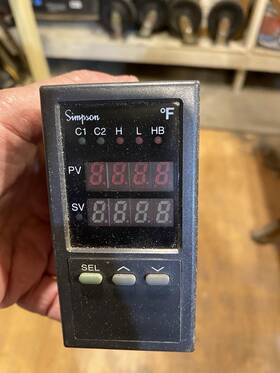
( Brand: Simpson ), ( Manufacturer Part Number: P21201300 ), ( Part Type: Controller ), ( Analog/digital: Digital )
Review SIMPSON Temperature Controller
The **Simpson P21201300** is a high-performance, precision-engineered temperature controller designed to deliver unmatched reliability and versatility in industrial, laboratory, and manufacturing applications. This advanced device combines cutting-edge technology with robust construction to provide seamless temperature regulation, making it an indispensable tool for processes requiring strict thermal control. Built with a **digital PID (Proportional-Integral-Derivative) control algorithm**, the P21201300 ensures precise and responsive temperature management, minimizing overshoot and stabilizing systems with exceptional accuracy. Its **wide input voltage range (110 240V AC)** and **adjustable output power (up to 2000W)** accommodate a broad spectrum of heating elements, including resistance heaters, band heaters, and cartridge heaters, while its **high-temperature tolerance (up to 1000 C)** ensures compatibility with demanding environments. The controller features a **large, backlit LCD display** with intuitive menu navigation, allowing operators to effortlessly set and monitor temperature setpoints, ramp rates, and hold times with minimal effort. Additionally, its **RS-485 communication interface** enables seamless integration with SCADA systems, PLCs, or other industrial networks, facilitating remote monitoring and data logging for enhanced process optimization. Constructed from **durable, corrosion-resistant materials**, the P21201300 is built to withstand harsh conditions, offering long-term operational stability in both cleanroom and industrial settings. Whether used in **material testing, chemical processing, or precision manufacturing**, this temperature controller delivers consistent performance, energy efficiency, and adaptability, making it a cornerstone for applications where thermal precision is critical.
### **Pros and Cons of buying a Simpson P21201300 Temperature Controller**
#### **Pros**
1. **High Precision and Accuracy** The P21201300 is designed for precise temperature control, making it suitable for applications requiring tight tolerances, such as industrial processes, laboratory equipment, or HVAC systems.
2. **Reliable and Durable** Simpson is a well-established brand known for producing robust control systems. This unit is built to withstand frequent use and environmental variations, reducing the risk of frequent failures.
3. **User-Friendly Interface** It features a clear digital display and intuitive controls, allowing for easy programming and monitoring of temperature settings without requiring advanced technical expertise.
4. **Wide Temperature Range** The controller supports a broad range of temperature settings, making it versatile for different applications, from low-temperature cooling to high-temperature heating.
5. **Modular and Expandable** Some models in the P2120 series allow for additional inputs and outputs, enabling integration with sensors, relays, or other control systems for more complex setups.
6. **Energy Efficiency** By maintaining precise temperature control, it helps optimize energy usage, reducing unnecessary heating or cooling cycles.
7. **Compatibility with Various Sensors** It can interface with different types of temperature sensors (e.g., thermocouples, RTDs, or thermistors), making it adaptable to different measurement needs.
8. **Remote Monitoring Capabilities** Some advanced versions support remote monitoring via communication protocols (e.g., Modbus), allowing for better system management.
9. **Low Maintenance Requirements** Due to its solid construction and minimal moving parts, it typically requires little upkeep compared to mechanical thermostats.
10. **Industrial-Grade Build** Suitable for harsh environments, including factories, laboratories, and outdoor installations, where reliability is critical.
#### **Cons**
1. **Higher Initial Cost** Compared to basic mechanical thermostats or simpler digital controllers, the P21201300 is more expensive, which may be a barrier for small businesses or hobbyists on a tight budget.
2. **Complexity for Beginners** While user-friendly, its advanced features (e.g., PID tuning, multi-stage control) may overwhelm users unfamiliar with temperature control systems, potentially leading to misconfiguration.
3. **Limited Built-in Safety Features** Some models may lack advanced safety protocols (e.g., auto-reset on overload, fail-safe modes) unless specifically configured, which could pose risks in critical applications.
4. **Dependence on Power Supply** Unlike mechanical systems, it requires a stable power source. Power outages or voltage fluctuations could disrupt operation unless a backup power solution is implemented.
5. **Potential for Software Glitches** Digital controllers can occasionally experience firmware issues or require updates, which may temporarily disrupt functionality if not properly maintained.
6. **Sensor Dependency** The accuracy of the controller relies heavily on the quality of the connected sensor. A faulty or improperly calibrated sensor can lead to incorrect temperature readings and control.
7. **Limited Physical Indicators** Some users may prefer controllers with more tactile feedback (e.g., audible alerts, visual warnings) beyond the digital display, which can be less noticeable in noisy environments.
8. **Warranty and Support Variability** Depending on the region and distributor, warranty coverage and technical support quality may vary, potentially leading to delays in resolving issues.
9. **Not Ideal for Extremely High-Precision Applications** While precise, it may not match the level of accuracy required for ultra-sensitive applications (e.g., semiconductor manufacturing or cryogenic systems), which may need specialized controllers.
10. **Physical Size and Installation Space** The unit occupies more space than compact digital thermostats, which could be a constraint in tight installation areas.
---
### **Conclusion**
The **Simpson P21201300 Temperature Controller** is a high-quality, reliable, and versatile tool for applications requiring precise temperature management. Its strengths lie in its accuracy, durability, user-friendly design, and compatibility with a wide range of sensors and systems. However, its higher cost, complexity for non-technical users, and dependency on power and sensors are notable drawbacks.
For **industrial, commercial, or laboratory settings** where reliability and precision are critical, this controller is an excellent investment. It is particularly well-suited for applications such as:
- HVAC systems in large buildings.
- Industrial process control (e.g., heating, cooling, or drying processes).
- Laboratory equipment (e.g., incubators, ovens, or refrigeration units).
- Environmental chambers or test chambers.
For **small-scale or budget-conscious users**, such as hobbyists or small businesses, a simpler or lower-cost alternative (e.g., a basic digital thermostat or a programmable controller with fewer features) might be more appropriate.
---
### **Recommendation**
**Buy the Simpson P21201300 if:**- You need a **reliable, precise, and durable** temperature controller for **industrial, commercial, or laboratory use**.
- Your application requires **multi-stage control, PID tuning, or compatibility with multiple sensors**.
- You are willing to invest in a **long-term solution** that reduces energy waste and minimizes manual intervention.
- You have **some technical knowledge** or can consult with an expert to ensure proper setup and maintenance.
**Consider an alternative if:**- You are working on a **tight budget** and can find a simpler, lower-cost controller that meets your basic needs.
- Your application does **not require high precision** (e.g., residential heating or cooling).
- You prefer **plug-and-play simplicity** without advanced features like PID control or remote monitoring.
- You need **portable or ultra-compact** solutions (e.g., for small appliances or DIY projects).
Ultimately, the P21201300 is a **strong choice for professional and industrial applications** where performance and reliability are prioritized over cost. For less demanding uses, evaluating alternatives may lead to a more cost-effective solution.
Details:
Mfg original box and packing. Powers up but can not test.
part #: p21201300 price
- $14.68
specifications temperaturcontr:
- brand: Simpson
- mpn: P21201300
- part type: Controller
- analog/digital: Digital
returns temperaturcontr:
- time: 30 Days
- policy: Returns Accepted
- method: Money back
- paid by: Buyer
payments temperaturcontr:
- wallet: Apple-pay
- other
- credit card: Visa
general temperaturcontr:
- condition: Used
- PLCs HMIs > PLC Peripheral Modules > PLC Temperature Modules
offer temperaturcontr:
- started: April 11, 2026
- sold: 0
- best offers: True
- options: Ship-to-home
- quantity: 1
- availability: In Stock
seller temperaturcontr:
- city: wood stock, Connecticut
- # reviews: 31
- rating: 100.0%
shipping temperaturcontr:
- type: Calculated
- carrier: USPS
- transit: 4-9 Days
- cost: $8.72
- class: Standard
- service: USPS Ground Advantage
Simpson P21201300 Is Similar To:
- Hk-35-1-0140-0-1-0 Hawk Simpson Process Temperature (46.2% similar) I do not attempt to make money on shipping. I do not want to lose it either. I have a one day turnaround and ship Mon-Fri. You pay actual us postal service shipping with delivery confirmation...(September 23rd, 2017)
- Hk-35-1-0720-0-2-0 Simpson Hawk Hk35 Temperature (47.7% similar) Simpson hawk temperature controller power supply: vac relays: 2 input 1-5 CDC part Gk this item is gently used. Please see photos. The part is in manufacturers box...(October 29th, 2017)
- Hk-40-0-0000-0-0-0 Simpson Hawk Controller (48.8% similar) It is untested but I have no reason to believe does not work. This unit is in great physical condition...(September 25th, 2018)
- Hk-45-1-0130-0-2-0 Simpson Temperature Controller Used (63.8% similar) If another carrier such as ups or FedEx is required to ship due the size, then shipping costs may change...(March 11th, 2018)
- Hk35-1-0710-1-0-0 Simpson Hawk Temperature Controller (66.7% similar) If another carrier such as ups or FedEx is required to ship due the size, then shipping costs may change...(January 29th, 2018)
- S-5100514 Simpson Temperature Controller (75% similar) Automotive medical truck parts networking communications electric motors breakers power step featured items lot of 2000 Tao-saw technology test TV0119A ICC, CO, dam, AMD, 50 ohms emir fail us working pneumatic slighting laser material handling packing more industrial equipment electrical ...(July 16th, 2018)
- 0-200c Instrument 24662 120v Digital 2871 Temperature Controller Panel Simpson (47.5% similar) Simpson temperature controller used deg c 120 vac 50 400HZ 3a photos are of actual device. The equipment may have broken or missing parts and may be in need of some rework and or repair...(September 15th, 2015)
- Hk35-1-0111-0-0-2 003137 Hk-35-1-0111-0-0-2 Simpson Hawk Hk35temperature Controller (48.8% similar) Model number HK35 price is for both controllers. Used, Simpson hawk HK35 temperature controllers. Both controllers in good working condition. Guaranteed to work or your money back...(October 28th, 2015)
- Hk-35-1-0130-3-1-0 Temperature Controller Simpson Hawk Excellent 110 220 V (50.9% similar) ...(April 10th, 2016)
- Simpson Hk-35-1-0550-0-2-0 Temperature Controller T54054 (70.8% similar) Extra information:: plastic broken on top. We proudly sell hard-to-find parts, components, and machines to makers manufacturers. Input: 750 vac. Glad you stopped by. Simpson HK-35-1-0550-0-2-0 temperature controller T54054 brand:: Simpson, condition: this is a used item, in good condition and ...(January 30th, 2025)