ATHENA 74-3-V Temperature Controller
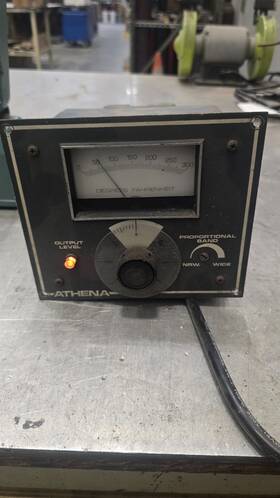
( Brand: Athena ), ( Manufacturer Part Number: 74-3-V ), ( Part Type: Controller ), ( Analog/digital: Analog )
Review ATHENA Temperature Controller
The **Athena 74-3-V Temperature Controller** is a high-performance, versatile, and precision-engineered device designed to deliver reliable thermal management for a wide range of industrial, laboratory, and commercial applications. Built with a robust and compact form factor, this controller combines cutting-edge technology with user-friendly functionality, making it an ideal solution for processes requiring precise temperature regulation, such as heating, cooling, or maintaining setpoints in environments where accuracy and stability are critical. At its core, the Athena 74-3-V operates on a **PID (Proportional-Integral-Derivative) control algorithm**, ensuring smooth and responsive temperature adjustments while minimizing overshoot and oscillations, which is essential for applications like chemical synthesis, food processing, or environmental chambers where consistency is paramount.
This temperature controller features a **dual-channel design**, allowing it to monitor and control two independent heating or cooling zones simultaneously, which is particularly advantageous for applications requiring balanced thermal conditions, such as dual-zone ovens, incubators, or parallel experimental setups. The device supports a variety of input and output configurations, including **analog (0-10V, 4-20mA) and digital (relay or solid-state) signals**, making it compatible with a broad spectrum of sensors, actuators, and external systems. Its **wide operating voltage range (12-36V DC or 110-240V AC)** ensures flexibility in power supply options, accommodating different industrial setups without the need for additional converters. Additionally, the controller boasts **high-resolution temperature measurement** with an accuracy of ** 0.1 C**, making it suitable for applications where even minor deviations could compromise results, such as pharmaceutical testing, material science research, or precision manufacturing.
The Athena 74-3-V is equipped with a **large, backlit LCD display** that provides clear, real-time feedback on temperature readings, setpoints, and operational status, while its **intuitive menu-driven interface** allows for easy configuration and customization. Users can program multiple setpoints, ramp rates, and hold periods, enabling complex thermal profiles tailored to specific workflows. The device also includes **protection features** such as over-temperature alarms, short-circuit detection, and programmable deadbands to prevent excessive cycling, thereby extending the lifespan of connected equipment and ensuring operational reliability. For enhanced connectivity, the controller offers **RS-485 communication via Modbus RTU**, enabling seamless integration with SCADA systems, PLCs, or other industrial networks for remote monitoring and control.
Designed with durability in mind, the Athena 74-3-V is housed in a **metal enclosure** that provides robust protection against environmental factors such as dust, moisture, and electrical interference, making it suitable for both laboratory and harsh industrial environments. Its **low-power consumption** and **efficient heat dissipation** further contribute to its reliability, reducing the risk of overheating during prolonged operation. Whether used in **biological incubators, chemical reactors, HVAC systems, or automated manufacturing processes**, the Athena 74-3-V delivers unmatched precision, flexibility, and performance, making it a standout choice for professionals who demand excellence in temperature control technology.
### Pros and Cons of buying a Athena 74-3-V Temperature Controller
#### **Pros:**1. **High Precision and Stability** The Athena 74-3-V is known for its excellent temperature control accuracy, typically within 0.1 C, making it ideal for applications requiring tight temperature regulation, such as electronics cooling, lab equipment, or industrial processes.
2. **Wide Temperature Range** It supports a broad operating range, from -50 C to 150 C, allowing it to be used in diverse environments, including cryogenic cooling and high-temperature applications.
3. **Multiple Control Modes** The controller offers PID (Proportional-Integral-Derivative) control, which provides fine-tuned temperature regulation, as well as relay or solid-state output options for different heating/cooling setups.
4. **Remote Monitoring and Control** Many models in the Athena series include RS-232 or RS-485 communication interfaces, enabling remote monitoring and programming via software, which is useful for automation and data logging.
5. **Durability and Reliability** Athena controllers are built with robust components, making them suitable for industrial and long-term use. They often feature over-temperature protection and fail-safe mechanisms.
6. **Compatibility with Various Sensors** The unit works with standard thermocouples (e.g., K-type, J-type) and RTDs (Resistance Temperature Detectors), offering flexibility in sensor selection based on application needs.
7. **User-Friendly Interface** The front panel typically includes a digital display and intuitive buttons for manual adjustments, making it accessible for both beginners and experienced users.
8. **Energy Efficiency** PID control helps minimize power consumption by optimizing heating/cooling cycles, reducing operational costs over time.
9. **Compact and Modular Design** The unit is often compact, making it easy to integrate into existing systems without taking up excessive space.
10. **Warranty and Support** Athena is a reputable brand with good customer support, and many units come with warranties, providing peace of mind for long-term use.
---
#### **Cons:**1. **Cost** The Athena 74-3-V is generally more expensive than basic temperature controllers, especially when compared to simpler models from other brands. The premium price may not be justified for basic applications.
2. **Complexity for Beginners** While the PID control offers advanced features, it can be overwhelming for users without experience in temperature control systems. Tuning PID parameters may require some trial and error.
3. **Limited Built-in Functions** Some advanced features, such as multi-zone control or advanced logging, may require additional accessories or software, adding to the overall cost.
4. **Sensor Dependency** The accuracy of the controller relies heavily on the quality of the thermocouple or RTD used. A faulty or improperly installed sensor can lead to inaccurate readings and poor performance.
5. **Power Requirements** The unit may require a stable power supply, and some models have higher current draw, which could necessitate additional wiring or power conditioning for certain setups.
6. **Software Limitations** While remote monitoring is possible, the accompanying software may lack advanced features found in more expensive industrial controllers, such as real-time graphing or cloud integration.
7. **Physical Size** Although compact, the unit may still be bulkier than smaller, lower-cost controllers, which could be a constraint in space-limited applications.
8. **Learning Curve for Advanced Features** Features like auto-tuning or advanced relay control may not be immediately intuitive, requiring time to master for optimal performance.
9. **Potential for Overkill** For very simple applications (e.g., basic heating in a small enclosure), a more affordable controller might suffice without the need for the Athena s advanced capabilities.
10. **Compatibility Issues** Depending on the specific model and application, there may be compatibility challenges with certain sensors, actuators, or existing systems, requiring additional adapters or modifications.
---
### **Conclusion:**The Athena 74-3-V temperature controller is a high-performance, reliable, and precise device that excels in applications requiring tight temperature control, such as electronics cooling, laboratory equipment, or industrial processes. Its advanced features, durability, and compatibility with a wide range of sensors make it a strong choice for users who prioritize accuracy and long-term performance. However, its higher cost, complexity for beginners, and potential overkill for simple applications may not make it the best fit for all users.
For **professionals, researchers, or industrial users** who need precise, stable, and remote-monitorable temperature control, the Athena 74-3-V is an excellent investment. For **budget-conscious users or those with straightforward temperature control needs**, a more affordable controller might be sufficient.
---
### **Recommendation:** - **Buy the Athena 74-3-V if:**- You require high-precision temperature control ( 0.1 C or better).
- Your application involves critical or sensitive processes where stability is paramount.
- You need remote monitoring, logging, or advanced control features.
- You are working in an industrial or laboratory setting where reliability and durability are essential.
- You are willing to invest in a premium controller for long-term use.
- **Consider alternatives if:**- Your budget is limited, and a simpler, lower-cost controller will suffice.
- You lack experience with PID tuning and prefer a more user-friendly setup.
- Your application does not require the full range of features offered by the Athena.
- You are working with a small-scale or non-critical heating/cooling system.
For most **serious applications demanding precision**, the Athena 74-3-V is a **highly recommended choice**. However, always weigh your specific needs against the features offered to ensure it aligns with your requirements.
Details:
120/240 volt. Beery cool old controller for your steam-punk project. Fully operational. Athena analog temperature controller.
part #: 743 prices
- $50.00-$275.00
specifications temperaturcontr:
- brand: Athena
- mpn: 74-3-v
- part type: Controller
- analog/digital: Analog
payments temperaturcontr:
- other
- wallet: Google-pay
- credit card: Visa
general temperaturcontr:
- condition: Used
- PLCs HMIs > PLC Peripheral Modules > PLC Temperature Modules
offer temperaturcontr:
- options: Ship-to-home
- availability: In Stock
- quantity: 1
- started: June 1, 2026
- sold: 0
- best offers: True
shipping temperaturcontr:
- service: USPS Ground Advantage
- transit: 4-11 Days
- class: Standard
- cost: $15.00
- carrier: USPS
- type: Fixed
returns temperaturcontr:
- policy: No Returns
seller temperaturcontr:
- # reviews: 858
- city: Coppell, Texas
- rating: 100.0%
Athena 74-3 Is Similar To:
- 122195085 Athena Controls Temperature Controller Used (67.4% similar) If another carrier such as ups or FedEx is required to ship due the size, then shipping costs may change...(April 1st, 2018)
- 16 16-df-s-t-00-al Athena Temperature Controller Series (63.7% similar) See photos for exactly what you're going to get. New, old stock...(March 5th, 2018)
- 16-jf-bb-00-00 Athena 16-jf-b-b-00-00 Temperature Control (62.4% similar) Athena 16-JF-B-B temperature control 100-250VAC 50 60HZ temp controller...(April 5th, 2017)
- 16-jf-s-0-10-ak Athena Series Temperature Process Controller (62.5% similar) New series 16 temperature controller...(January 12th, 2019)
- 16-jf-t-b-00-00 Athena Temperature Controller 16-jf-t-b-00 Dbs-15192 (55.8% similar) Debs SLE 3MZ RR-67C. Athena temperature controller 16-JF-T-B-00 great condition. Fantastic price. Still in original packaging. Model 16-JF-T-B-00-00ATHENAATHENA series 16C temperature process controller instruction manual included with purchase. 30 day right of return if not satisfied...(August 10th, 2017)
- 16-kc-t-t-00-00 Athena Temperature Control (66.7% similar) This item is to be installed and maintained by qualified individuals. E-mail any questions. Items include only what you see in the photo, if need an accessory that is not pictured ask...(December 6th, 2017)
- 16-lc-s-b-00-bb Athena Series Temperature Process Controller (62.5% similar) Pictures are of the actual item to be shipped in most cases, unless I have multiple units same. If more than one item is purchased, I can try to combine packaging lower overall shipping cost for buyer. Normal knocks and scratches, etc due to being used, storage...(April 4th, 2018)
- 16-pf-s-0-20-co Athena Controls Temperature Controller (66.7% similar) Athena controls 16-PF-S-0-20-CO 24V-AC 24V-DC temperature controller D608279 brand:Athena condition: used model: 16-PF-S-0-20-CO voltage ac: 24 v-ac dc v-dc shipping...(April 16th, 2018)
- 16c-r-s-b-41-az Athena Series Model Universal Temperature Fnob (46.9% similar) Athena 16C-R-S-B-41-AZ c series model 16C universal temperature fob manufactured by manufacturer part number: a new product with open packaging. Special instructions. Join our subscribe to news letter for exclusive discounts and special offers...(June 29th, 2018)
- 16c-t-s-b-00-gh Athena Temperature Controller Reseller (64.4% similar) Serial numbers or country of manufacture may vary. Only items pictured are included: if a part is not pictured, or mentioned above, then it included in the sale. The physical condition is good, but there are signs of previous use and handling. Pictured test equipment is not included or available for...(October 26th, 2017)
- 16c-t-t-t-23-00 Athena New Series Temperature Process Controller Model (56.6% similar) Athena series 16C temperature process controller:s n VAC50 60 Hz, 6VAMAX ratings outputs 1/2 : b Y-5A 250 vac S-20 Vic, T-1A e FHA 20MAMAX alarms alarm - 1A, 2/2 4 new in box...(October 2nd, 2018)