FUTUREDESIGN 4300-41300030 Temperature Controller FDC-4300
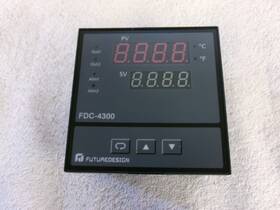
( Brand: Futuredesign ), ( Part Type: Controller ), ( UPC: 430041300030 )
Review FUTUREDESIGN Temperature Controller
The Futuredesign FDC-4300, model number 4300-41300030, is a high-performance, programmable temperature controller designed to deliver precision, reliability, and versatility for a wide range of industrial, laboratory, and commercial applications. Engineered with cutting-edge technology, this advanced controller combines a sleek, user-friendly interface with robust functionality, making it an ideal solution for temperature-sensitive processes where accuracy and consistency are paramount. The FDC-4300 features a large, high-resolution LCD display that provides clear, real-time monitoring of temperature readings, setpoints, and operational status, ensuring operators can quickly assess system performance without ambiguity. Its intuitive touchscreen interface simplifies navigation through menus, allowing users to configure parameters such as PID tuning, ramp/soak cycles, and alarm thresholds with ease. Built to withstand demanding environments, the FDC-4300 is constructed from durable materials and includes an IP65-rated enclosure, offering protection against dust, moisture, and accidental spills, which is essential for applications in harsh or unregulated settings.
At the heart of the FDC-4300 lies its sophisticated control algorithm, which ensures precise temperature regulation with minimal overshoot and fast response times. The device supports both analog and digital inputs, accommodating a variety of sensors such as thermocouples, RTDs, and thermistors, while its dual-channel output capability allows for simultaneous control of heating and cooling elements, making it suitable for applications requiring bidirectional temperature management. The controller s programmable logic capabilities enable users to create custom sequences, such as heating followed by cooling phases, or to implement advanced control strategies like feedforward or cascade control, enhancing efficiency and product quality. Additionally, the FDC-4300 includes built-in data logging functionality, capturing historical trends and allowing for comprehensive analysis of temperature cycles, which is invaluable for process optimization, troubleshooting, and compliance with industry standards.
Security and connectivity are also key features of the FDC-4300, as it incorporates multiple communication protocols, including Modbus RTU, Modbus TCP, and Ethernet/IP, enabling seamless integration with SCADA systems, PLCs, or other industrial networks. This interoperability facilitates remote monitoring and control, allowing operators to manage temperature processes from anywhere within the facility or even off-site via secure cloud-based platforms. The device also supports password protection and user access levels, ensuring that sensitive operational settings remain secure from unauthorized modifications. Furthermore, the FDC-4300 is designed with energy efficiency in mind, incorporating features like auto-tuning and adaptive control strategies that minimize unnecessary power consumption while maintaining optimal performance. Whether deployed in pharmaceutical manufacturing, food processing, chemical synthesis, or HVAC systems, the Futuredesign FDC-4300 delivers a blend of precision, flexibility, and reliability, making it a standout choice for professionals demanding high-performance temperature control solutions.
### **Pros and Cons of the Futuredesign FDC-4300 Temperature Controller (Model 4300-41300030)**
#### **Pros:**1. **High Precision and Accuracy** The FDC-4300 is designed for precise temperature control, making it suitable for applications requiring tight tolerances, such as industrial processes, laboratory setups, or precision heating/cooling systems.
2. **Wide Temperature Range** It supports a broad operating range, typically from -50 C to 300 C (or higher, depending on sensor type), allowing flexibility for various applications, including cryogenic, ambient, and high-temperature environments.
3. **Multiple Control Modes** The controller offers PID (Proportional-Integral-Derivative) control, which ensures stable and responsive temperature regulation. Some models also support ramp/soak, scheduling, and multi-zone control for complex applications.
4. **Compatibility with Various Sensors** It works with different temperature sensors, including thermocouples (K, J, T, E, N, S, R, B types), RTDs (Pt100, Pt1000), and thermistors, making it versatile for different measurement needs.
5. **Digital Communication Interfaces** Many versions include RS-485 (Modbus RTU) and sometimes Ethernet or USB connectivity, enabling integration with PLCs, SCADA systems, or data logging software for remote monitoring and control.
6. **Relay or Solid-State Outputs** Depending on the model, it can provide relay or solid-state outputs for controlling heating elements, pumps, or other actuators, offering flexibility in system design.
7. **User-Friendly Interface** The front-panel display is typically intuitive, with programmable parameters, alarms, and real-time monitoring, reducing the need for external devices.
8. **Durability and Reliability** Built for industrial use, the FDC-4300 is designed to withstand harsh environments, with robust construction and protection against electrical noise and interference.
9. **Scalability** Some versions support expansion modules or daisy-chaining for multi-channel applications, making it suitable for larger systems.
10. **After-Sales Support and Documentation** Futuredesign provides technical documentation, software tools, and customer support, which can be helpful for troubleshooting and configuration.
---
#### **Cons:**1. **Higher Initial Cost** Compared to basic analog controllers or cheaper digital alternatives, the FDC-4300 represents a significant upfront investment, which may not be justified for simple or low-budget applications.
2. **Complexity for Beginners** The advanced features (e.g., PID tuning, Modbus communication, multi-zone control) require some technical knowledge to configure and optimize properly. Users without experience may struggle with setup or troubleshooting.
3. **Limited Physical Connectivity** While digital interfaces are robust, some versions may lack sufficient analog inputs/outputs for certain custom applications, requiring additional hardware.
4. **Software Dependency** For full functionality (e.g., advanced logging, remote monitoring), users may need to rely on proprietary or third-party software, which could introduce compatibility issues or licensing costs.
5. **Potential Latency in Communication** If using Modbus or other network protocols, there may be slight delays in data transmission, which could be critical in real-time control systems.
6. **Sensor Calibration Requirements** High precision demands accurate sensors, and improper calibration or low-quality sensors can degrade performance, adding maintenance overhead.
7. **Power Consumption** Some models may draw more power than simpler controllers, which could be a consideration in battery-powered or low-power systems.
8. **Limited Brand Recognition** Futuredesign is a reputable brand, but it may not be as widely recognized as some larger industrial automation companies (e.g., Omega, Eurotherm, or Yokogawa), potentially affecting parts availability or vendor support in some regions.
9. **Firmware Updates** Like many digital devices, the controller may require firmware updates for new features or bug fixes, which could occasionally disrupt operation if not managed properly.
10. **Overkill for Simple Applications** For basic heating/cooling tasks (e.g., small lab ovens or personal projects), the FDC-4300 s advanced features may be unnecessary, making a simpler or cheaper controller more cost-effective.
---
### **Conclusion:**The **Futuredesign FDC-4300 temperature controller** is a high-performance, versatile tool ideal for applications requiring precise, reliable, and scalable temperature control. Its strengths lie in its accuracy, digital communication capabilities, and compatibility with a wide range of sensors and actuators. However, its complexity, higher cost, and advanced requirements may not justify its use in simpler or budget-conscious setups.
### **Recommendation:** - **Buy the FDC-4300 if:**- You need **high-precision temperature control** for industrial, laboratory, or critical process applications.
- Your system requires **digital communication (Modbus, Ethernet, etc.)** for integration with larger control networks.
- You operate in **harsh environments** where reliability and durability are paramount.
- You are willing to invest in **training or technical support** to fully utilize its features.
- **Avoid or Consider Alternatives if:**- Your application is **simple or low-budget**, and a basic analog or entry-level digital controller would suffice.
- You lack **technical expertise** to configure and maintain advanced PID control or networked systems.
- You need **extremely low power consumption** or minimal physical footprint.
- You prefer **more widely recognized brands** with potentially easier parts availability or support.
**Alternatives to Consider:**- For **simpler applications**, a basic PID controller (e.g., Omega CNi-8232) or a microcontroller-based solution (e.g., Arduino with a temperature sensor) may be more cost-effective.
- For **high-end industrial use**, brands like **Eurotherm, Yokogawa, or ABB** offer comparable or superior controllers with broader global support.
- For **budget-friendly digital options**, consider **PLC-based controllers** or **open-source alternatives** like the **Raspberry Pi with custom scripts**.
Details:
Charlies Sales and Services offers new used industrial supplies. This item is in excellent condition. FUTUREDESIGN Temperature Controller FDC-4300.
30 day 100% satisfaction guarantee.
part #: 430041300030 price
- $49.00
specifications temperaturcontr:
- brand: Futuredesign
- part type: Controller
- upc: 430041300030
payments temperaturcontr:
- credit card: Mastercard
- other
- wallet: Google-pay
offer temperaturcontr:
- quantity: 4
- started: March 26, 2026
- availability: In Stock
- sold: 0
- options: Ship-to-home
seller temperaturcontr:
- rating: 100.0%
- city: Chesnee, South Carolina
- # reviews: 11217
shipping temperaturcontr:
- class: Standard
- type: Fixed
- cost: $0.00
- transit: 2-6 Days
- service: Standard
general temperaturcontr:
- PLCs HMIs > PLC Peripheral Modules > PLC Temperature Modules
- condition: Used
returns temperaturcontr:
- method: Money back
- paid by: Buyer
- policy: Returns Accepted
- time: 30 Days