ATHENA 16CRSB42 Temperature Process Controller Module Unit Display
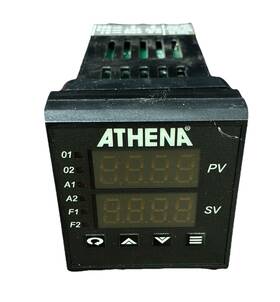
( Brand: Athena ), ( Manufacturer Part Number: 16CRSB42 ), ( Part Type: Display Controller Module Unit ), ( Unit Type: Unit ), ( Din Size: 1/16 ), ( Country Of Origin: Italy )
Review ATHENA 16c Series Temperature And Process Controller Module Display Unit
The **Athena 16CRSB42** is a high-performance, modular **16-channel temperature process controller and display unit** designed for precision industrial automation, offering unparalleled reliability and flexibility in temperature monitoring and control applications. Engineered with advanced microcontroller technology, this robust unit seamlessly integrates into complex process control systems, making it an ideal solution for industries such as HVAC, manufacturing, food processing, pharmaceuticals, and laboratory environments where accurate temperature regulation is critical. The **16CRSB42** features a **large, high-contrast LCD display** with intuitive graphical interfaces, allowing operators to monitor real-time temperature readings, setpoints, and control parameters with ease. Its **4-20mA analog output** ensures seamless compatibility with PLCs, DCS systems, and other automation infrastructure, while the **RS-485 Modbus RTU communication interface** enables seamless data logging, remote monitoring, and integration with SCADA systems for enhanced process visibility.
Built to withstand demanding industrial conditions, the **Athena 16CRSB42** incorporates a **durable metal enclosure** with IP65 protection, ensuring resistance against dust, moisture, and harsh environmental factors. Its **wide operating temperature range** (typically -10 C to 60 C) guarantees stable performance in diverse climates, while its **low-power design** minimizes energy consumption without compromising functionality. The module supports **multiple control algorithms**, including PID, ON/OFF, and ramp/soak, allowing precise regulation of heating or cooling processes. Each of its **16 independent channels** can be configured for **thermocouple (J, K, T, E, N, S, R, B), RTD (Pt100, Pt1000), or voltage/current inputs**, providing versatility for a wide range of sensor types. Advanced features such as **alarm thresholds, hysteresis control, and multi-stage control** further enhance its adaptability, ensuring optimal process efficiency and safety.
The **Athena 16CRSB42** also excels in **data management and diagnostics**, offering built-in **event logging, fault detection, and historical trend analysis** to facilitate predictive maintenance and troubleshooting. Its **user-friendly menu-driven interface** simplifies configuration, calibration, and parameter adjustments, reducing downtime and operational complexity. Whether deployed in a **small-scale laboratory setup** or a **large-scale industrial facility**, this temperature controller module delivers **high accuracy ( 0.1 C for RTDs, 0.5 C for thermocouples)**, **fast response times**, and **long-term stability**, making it a cornerstone of modern process automation. With its **modular design**, it can be easily expanded or integrated into larger control networks, ensuring scalability for evolving industrial needs. The **Athena 16CRSB42** is not just a controller it is a **versatile, high-precision workhorse** that elevates process control to new levels of efficiency and reliability.
The **Athena 16CRSB42** is a 16-channel temperature process controller module with a built-in display, designed for industrial applications requiring precise temperature monitoring and control. Below is a detailed analysis of its pros and cons, followed by a conclusion and recommendation.
---
### **Pros of the Athena 16CRSB42**
1. **High Channel Capacity (16 Channels)**
The module supports 16 independent temperature measurement and control channels, making it suitable for applications requiring simultaneous monitoring of multiple sensors (e.g., furnaces, ovens, or batch processes). This eliminates the need for multiple standalone controllers, reducing wiring complexity and installation costs.
2. **Built-in Display and User Interface**
The integrated display allows for on-site monitoring without requiring external HMI or PC connectivity. This is beneficial in remote or harsh environments where additional hardware may be impractical. The interface typically includes features like PID tuning, alarm settings, and real-time data logging, enhancing usability.
3. **Precision and Reliability**
Athena controllers are known for their accuracy in temperature measurement and control, often with resolutions as fine as **0.1 C** or better. They are designed for industrial use, meaning they can handle high-temperature ranges (typically up to **1,800 C** or more, depending on sensor type) and provide stable performance under varying conditions.
4. **Modular and Expandable Design**
The 16CRSB42 can often be integrated into larger systems or paired with additional modules (e.g., communication interfaces like Modbus, Profibus, or Ethernet). This flexibility allows for scalability as process requirements grow.
5. **Local and Remote Control Capabilities**
Many models in this series support both local control (via the built-in keypad/display) and remote control (via communication protocols). This dual functionality is useful for applications where operators need to adjust settings manually but also require automation or integration with SCADA systems.
6. **Alarm and Safety Features**
The controller typically includes programmable alarms (high/low limits, rate of change, etc.) and safety features like fail-safe modes or emergency shutdown capabilities. These are critical for preventing equipment damage or safety hazards in industrial processes.
7. **Compatibility with Common Sensors**
It is designed to work with a wide range of temperature sensors, including **RTDs (Pt100, Pt500, Pt1000), thermocouples (J, K, T, E, N, S, B, R, etc.), and thermistors**. This versatility ensures compatibility with existing infrastructure in most industrial setups.
8. **Energy Efficiency and Cost Savings**
By precisely controlling temperature processes, the controller can optimize energy usage, reducing operational costs over time. For example, in heating applications, it can prevent overheating and extend the lifespan of equipment.
9. **Durable and Rugged Construction**
Athena controllers are typically built to withstand harsh industrial environments, including temperature fluctuations, vibration, and electrical noise. They often meet standards like **IP65 or higher** for protection against dust and water ingress.
10. **Technical Support and Warranty**
Athena (a brand under **Advantech**) is a well-established manufacturer with global support networks. The product usually comes with a warranty (e.g., 1 3 years), and technical documentation is readily available for troubleshooting and programming.
---
### **Cons of the Athena 16CRSB42**
1. **Limited Advanced Automation Features**
While the controller excels in basic temperature control, it may lack advanced features found in higher-end PLCs or DCS systems, such as:- Complex sequencing or recipe management.
- Advanced PID algorithms (e.g., adaptive or fuzzy logic).
- Built-in data analytics or machine learning capabilities.
If these features are required, additional software or hardware may be needed.
2. **Learning Curve for Programming**
The configuration of PID parameters, alarm thresholds, and communication settings can be complex for users without prior experience. The manual may require careful study, and training may be necessary for operators to fully utilize the controller s capabilities.
3. **Dependence on External Power Supply**
The controller requires a stable power source (typically **24V DC or 110/230V AC**). In environments with frequent power fluctuations or outages, an uninterruptible power supply (UPS) may be needed, adding to the system cost.
4. **Sensor and Wiring Complexity**
Managing 16 channels of sensors and wiring can become cumbersome, especially in space-constrained environments. Proper labeling and organization are essential to avoid confusion during maintenance or troubleshooting.
5. **Limited Communication Protocols (Depending on Model)**
While many Athena controllers support **Modbus RTU/TCP, Profibus, or Ethernet/IP**, some older or basic models may lack modern communication interfaces like **OPC UA, Ethernet/IP, or wireless (Wi-Fi/Bluetooth)**. This could limit integration with newer SCADA or IoT systems.
6. **Cost Relative to Simpler Controllers**
For applications requiring fewer channels (e.g., 4 8 channels), a simpler or standalone controller might be more cost-effective. The 16-channel model is best justified for high-channel-count applications where its features are fully utilized.
7. **Software Dependency for Advanced Features**
Some advanced functions (e.g., remote monitoring, historical data logging, or cloud connectivity) may require additional software licenses or third-party tools. This can introduce complexity and potential compatibility issues.
8. **Potential for Overkill in Small-Scale Applications**
If the application only requires monitoring or control of a few channels, a dedicated single-channel controller or a PLC with fewer I/O slots might be more efficient and less expensive.
9. **Firmware Updates and Compatibility**
Athena controllers rely on firmware for updates and bug fixes. If the manufacturer discontinues support for the model, users may face challenges with compatibility or security patches over time.
10. **No Built-in Logging for Long-Term Data Retention**
While some models offer basic data logging, extensive historical data retention may require an external logger or integration with a SCADA system. This can add to the overall system cost.
---
### **Conclusion**
The **Athena 16CRSB42** is a robust and versatile temperature process controller ideal for industrial applications requiring **high-channel-count temperature monitoring and control** with local display capabilities. Its strengths lie in its **precision, reliability, modularity, and compatibility with a wide range of sensors**, making it suitable for processes like batch cooking, furnace control, or multi-zone temperature management.
However, it may not be the best fit for applications needing **advanced automation, complex sequencing, or modern communication protocols** without additional hardware/software. The learning curve for programming and the potential for overkill in smaller setups are also considerations.
For users who prioritize **simplicity, cost efficiency, or minimal I/O requirements**, a simpler controller or PLC might be preferable. Conversely, for those managing **large-scale processes with multiple temperature zones**, the 16CRSB42 offers significant advantages in terms of efficiency and control.
---
### **Recommendation**
**Buy the Athena 16CRSB42 if:**- You require **16 or more independent temperature control channels** in a single unit.
- Your application demands **local monitoring and control** without relying on external HMIs.
- You need a **reliable, precision-engineered controller** for industrial environments with harsh conditions.
- You plan to integrate it with **Modbus, Profibus, or Ethernet-based systems** for remote monitoring.
- The **cost savings from reduced wiring and installation complexity** justify the investment.
**Consider alternatives if:**- Your application requires **fewer than 10 channels**, in which case a simpler controller or PLC may suffice.
- You need **advanced automation features** (e.g., recipe management, adaptive PID, or cloud connectivity), which may require additional software or a higher-end PLC.
- Your budget is tight, and a **lower-channel-count model** or a standalone controller would meet your needs.
- You prioritize **wireless or modern communication protocols** (e.g., OPC UA, MQTT) that may not be fully supported by this model.
**Final Suggestion:**If the 16CRSB42 aligns with your requirements, proceed with purchase, ensuring you have the necessary **sensors, power supply, and communication interfaces** for your setup. Pair it with **proper documentation and training** to maximize its potential. For long-term scalability, verify the manufacturer s support timeline and consider future-proofing with compatible communication modules.
Details:
The Athena 16C Series Temperature Process Controller 16CRSB42 Module Display Unit is a high-quality industrial automation device designed for precise control of temperature and processes. Made by Athena in Italy, this DIN size 1/16 unit is a reliable choice for PLC systems various industrial settings.
part #: 16crsb42 price
- $149.99
specifications temperaturcontr:
- brand: Athena
- mpn: 16crsb42
- part type: Display Controller Module Unit
- unit type: Unit
- din size: 1/16
- country of origin: Italy
payments temperaturcontr:
- credit card: Mastercard
- wallet: Paypal
- other
offer temperaturcontr:
- quantity: 1
- started: June 10, 2026
- sold: 0
- options: Ship-to-home
- availability: In Stock
- best offers: True
general temperaturcontr:
- PLCs HMIs > PLC Peripheral Modules > PLC Temperature Modules
- condition: Used
returns temperaturcontr:
- policy: No Returns
shipping temperaturcontr:
- cost: $8.60
- service: USPS Ground Advantage
- carrier: USPS
- type: Calculated
- transit: 2-6 Days
- class: Standard
seller temperaturcontr:
- rating: 99.5%
- city: New Lenox, Illinois
- # reviews: 1849
Athena 16CRSB42 Is Similar To:
- 122195085 Athena Controls Temperature Controller Used (50.7% similar) If another carrier such as ups or FedEx is required to ship due the size, then shipping costs may change...(April 1st, 2018)
- 16 16-df-s-t-00-al Athena Temperature Controller Series (48.5% similar) See photos for exactly what you're going to get. New, old stock...(March 5th, 2018)
- 16-jf-bb-00-00 Athena 16-jf-b-b-00-00 Temperature Control (43.5% similar) Athena 16-JF-B-B temperature control 100-250VAC 50 60HZ temp controller...(April 5th, 2017)
- 16-jf-s-0-10-ak Athena Series Temperature Process Controller (62.4% similar) New series 16 temperature controller...(January 12th, 2019)
- 16-jf-t-b-00-00 Athena Temperature Controller 16-jf-t-b-00 Dbs-15192 (44.3% similar) Debs SLE 3MZ RR-67C. Athena temperature controller 16-JF-T-B-00 great condition. Fantastic price. Still in original packaging. Model 16-JF-T-B-00-00ATHENAATHENA series 16C temperature process controller instruction manual included with purchase. 30 day right of return if not satisfied...(August 10th, 2017)
- 16-kc-t-t-00-00 Athena Temperature Control (42.3% similar) This item is to be installed and maintained by qualified individuals. E-mail any questions. Items include only what you see in the photo, if need an accessory that is not pictured ask...(December 6th, 2017)
- 16-lc-s-b-00-bb Athena Series Temperature Process Controller (62.4% similar) Pictures are of the actual item to be shipped in most cases, unless I have multiple units same. If more than one item is purchased, I can try to combine packaging lower overall shipping cost for buyer. Normal knocks and scratches, etc due to being used, storage...(April 4th, 2018)
- 16-pf-s-0-20-co Athena Controls Temperature Controller (47.4% similar) Athena controls 16-PF-S-0-20-CO 24V-AC 24V-DC temperature controller D608279 brand:Athena condition: used model: 16-PF-S-0-20-CO voltage ac: 24 v-ac dc v-dc shipping...(April 16th, 2018)
- 16c-r-s-b-41-az Athena Series Model Universal Temperature Fnob (39.2% similar) Athena 16C-R-S-B-41-AZ c series model 16C universal temperature fob manufactured by manufacturer part number: a new product with open packaging. Special instructions. Join our subscribe to news letter for exclusive discounts and special offers...(June 29th, 2018)
- 16c-t-s-b-00-gh Athena Temperature Controller Reseller (47.4% similar) Serial numbers or country of manufacture may vary. Only items pictured are included: if a part is not pictured, or mentioned above, then it included in the sale. The physical condition is good, but there are signs of previous use and handling. Pictured test equipment is not included or available for...(October 26th, 2017)
- 16c-t-t-t-23-00 Athena New Series Temperature Process Controller Model (67.5% similar) Athena series 16C temperature process controller:s n VAC50 60 Hz, 6VAMAX ratings outputs 1/2 : b Y-5A 250 vac S-20 Vic, T-1A e FHA 20MAMAX alarms alarm - 1A, 2/2 4 new in box...(October 2nd, 2018)